AIrt Guide
AIrt Guide · ACM C&C, CUI
Year:
2026
Timeframe:
8 Weeks
Tools:
Node.js, OpenAI
Category:
AI Research & Product Design
Role:
UX Researcher & Designer, First author
Team:
Wellesley HCI Lab

Overview
Designing Conversational AI that Scaffolds Art Beyond Initial Impressions
How might conversational AI scaffold interpretive creativity in a museum gallery, without becoming the voice of authority it was designed to replace?
The Design Problem
Most museum AI tools function as information delivery systems, optimized for navigation and retrieval, not reflection. This work asks a different question: what if a conversational AI helped visitors articulate and develop what they already notice, rather than redirecting them toward what the system thinks they should attend to?
24
participants
Museum visitors and staff
2
conditions
VTS and Formal Analysis
6
artworks
Davis Museum collection
C&C + CUI ’26
publication
ACM Creativity & Cognition · Conversational User Interfaces
THE DESIGN CHALLENGE
Meaning-making isn’t information retrieval.
Existing museum chatbots prioritize navigation, information retrieval, and gamified interaction. But meaning-making in front of an artwork is a creative act: personal, iterative, and resistant to definitive answers.
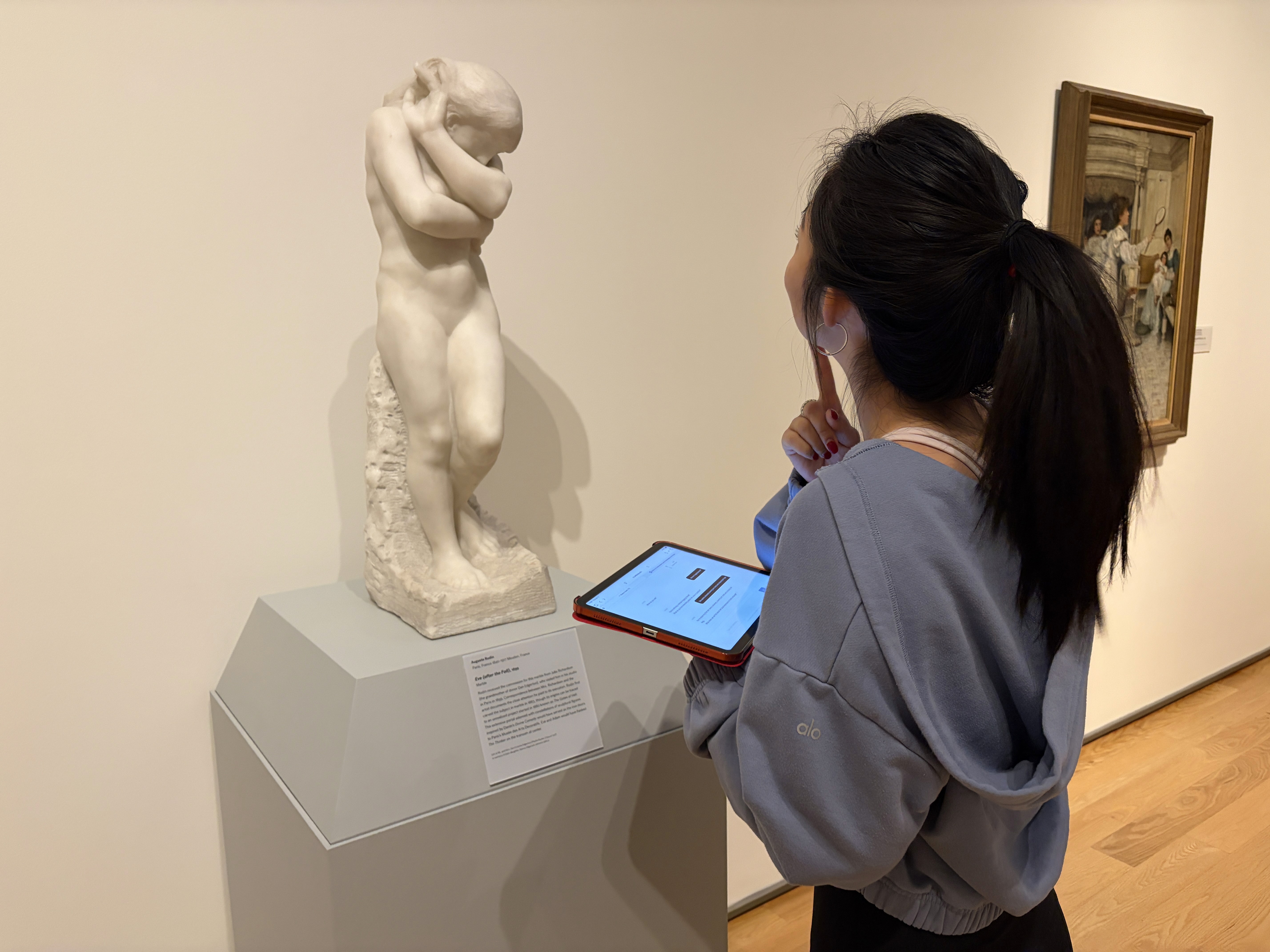
The AIrt Guide
Visitors select one of six Impressionist works at the Davis Museum and begin a conversation beside it. The chat interface stays visually identical across both conditions, isolating pedagogical structure as the variable under study.
The Collection

Street in Provincetown — Childe Hassam

Untitled — Le Phô

Eve (after the Fall) — Auguste Rodin

Calanques au bord du Loing (Soleil du Matin) — Alfred Sisley

My Family at Cotuit — Edmund Charles Tarbell

Waterloo Bridge — Claude Monet
Interfaces


HOW THE INTERFACES WORKED
The gallery selection screen anchored each conversation to the artwork a visitor was standing in front of, making the experience spatially grounded rather than a generic chatbot exchange. The chat interface then paraphrased observations and used follow-up prompts to guide attention—either expanding open-ended looking through VTS or sequencing formal elements through Formal Analysis. Together, these interactions encouraged longer observation, helped visitors articulate emerging interpretations, and gave them a low-stakes way to explore incomplete ideas.
DESIGNED FOR SAFEGUARDING
A guide, not an authority.
Every response was grounded in museum-authored Object Files for the artwork at hand. The goal was to make interpretation feel supported without allowing the system to invent history, context, or certainty.
01 · Grounded knowledge — the chatbot only used curated Object File material.
02 · Clear limits — out-of-scope questions were transparently redirected to museum staff.
03 · Future direction — communicate what is known, what is not, and offer a path to deeper context.
VALIDATION
Pressure-tested with art historians
Before the visitor study, five art historians pressure-tested the app’s conversations to identify where the guide needed stronger grounding, clearer boundaries, or more useful prompts.
5
art historians pressure-tested the experience
• Challenged response accuracy and the use of artwork context.
• Identified conversational dead ends and overconfident moments.
• Helped refine the guide before it entered the gallery.
Conversation Flow & Pedagogy
VISUAL THINKING STRATEGIES
“What do you see?”
Expands observation or requests visual justification. It avoids introducing interpretation, sustains ambiguity, and supports open-ended, participant-driven discovery.
FORMAL ANALYSIS
A guided visual sequence
Guides attention through color, light, spatial structure, and brushwork. Each turn paraphrases observation and introduces a new formal dimension.
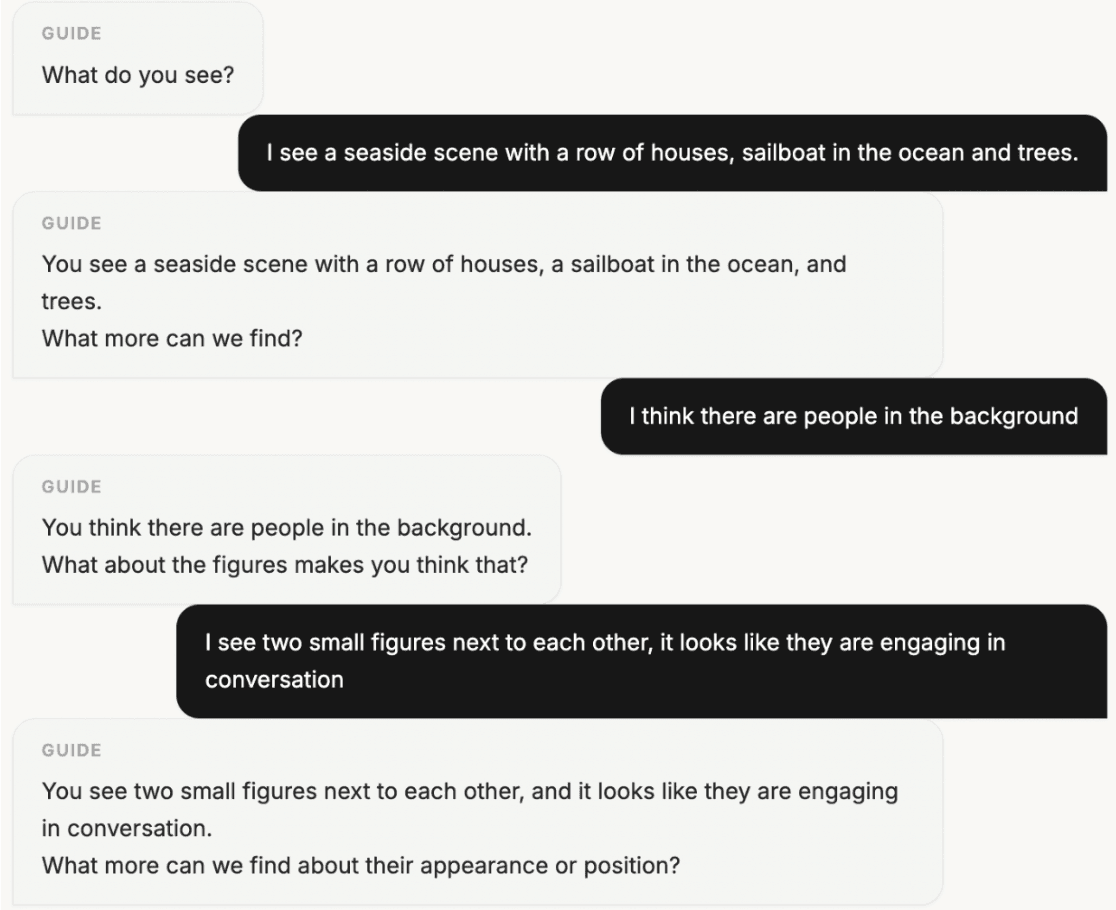
VTS flow

Formal Analysis flow
Research Approach
A comparative evaluative study tested two versions of the same system. Students were assigned between subjects, n=10 per condition; four museum faculty and staff formed a within-subjects expert panel. AReA pre/post surveys, linguistic analysis, and group discussion transcripts provided behavioral and experiential evidence.
SURVEY
AReA Pre/Post
Likert surveys before and after the session, analyzed with paired t-tests.
NLP
Linguistic signals
Parts-of-speech ratios, lexical diversity, word count, and sentence length.
QUALITATIVE
Group discussion
Thematic analysis of anonymized transcripts revealed social dynamics, discovery, and friction.
What We Found
KEY FINDING
Attitudes toward art did not significantly change for most participants, suggesting the system scaffolded experience without manufacturing enthusiasm. Arts-experienced students did show increased connectedness when viewing art.
VALUE 01
Deeper observation
Follow-up questions prompted visitors to notice texture, shadow, spatial relationships, and compositional choices.
VALUE 02
Articulation
Paraphrasing helped visitors clarify and sometimes revise interpretations, especially when less confident in art vocabulary.
VALUE 03
Low-stakes interaction
A non-human conversational partner reduced social pressure around sharing partial observations.
Contributed Design Principles
01
Flexible scaffold pedagogy
Recognize meaningful conversation endpoints and let visitors conclude gracefully.
02
Safe contextual interaction
Signal knowledge limits clearly while offering structured pathways to contextual expansion.
03
Connection across works
Help visitors trace themes and compositional relationships across the gallery, not only within one object.
04
Flexible interaction modalities
Use voice and eyes-up interaction to preserve the visual and spatial demands of the museum setting.
Broader Implications
This research is directly relevant to any product team building conversational AI features in content-rich, attention-demanding environments, not just museums: AI prompting works best when it helps users articulate and develop what they already notice, not when it redirects them toward what the system thinks they should attend to.
The conversational looping problem, where the system keeps pushing when the user is done, is a product design failure that appears in chatbots, recommendation flows, and onboarding experiences across industries. Recognizing conversation endpoints is not a museum-specific challenge.
The experience-moderation finding also has a product analog: users without an existing framework for a domain may not benefit from nuanced conversational scaffolding until more foundational engagement is established. This is an implication from the data, not a direct finding, but it suggests that adaptive scaffolding, which responds to what a user already knows rather than applying the same structure to everyone, is a meaningful design direction.
Finally, the device-attention finding maps directly onto any mobile product used in a physically engaging context. Designing for divided attention and eyes-up interaction is a UX challenge that extends well beyond gallery walls, from retail fitting rooms to cooking apps to navigation to any experience where the user’s primary attention belongs somewhere other than the screen.

