Designing GenAI for Creative Divergence
Published @ ACM IUI, C&C, CUI. Senior Thesis Work.
Year:
2026
Timeframe:
12 Weeks
Tools:
node.js, OpenAI
Category:
AI Research, Product Design
Role:
UX Researcher & Designer, First author
Team:
Wellesley HCI Lab

Overview
When AI Suggests and Humans Decide: designing for creative agency.
How might we design an AI system that expands what a creator considers, without deciding what they make?
The Design Problem
Most AI creativity tools automate execution, they make things for you. The real question is whether AI can instead expand what you consider, without taking over. In spaces like collage, where the creation process is physically and thematically rich, how can AI inspire creation while preserving user autonomy?
30
participants
Within-subjects study
5
suggestion cards
Distinct creative dimensions
4
significant measures
Creative exploration increased
IUI ’26
publication
ACM Intelligent User Interfaces
THE DESIGN CHALLENGE
Most AI creativity tools automate execution: they make things for you. This research asked whether AI could instead expand what a creator considers without deciding what they make. Physical collage introduced productive friction—participants had to interpret a suggestion and translate it into their own material choices.
STUDY AT A GLANCE
30 participants
Within-subjects, before-and-after study
Mixed methods: behavioral measures, reflections, and thematic coding
Published at ACM IUI ’26
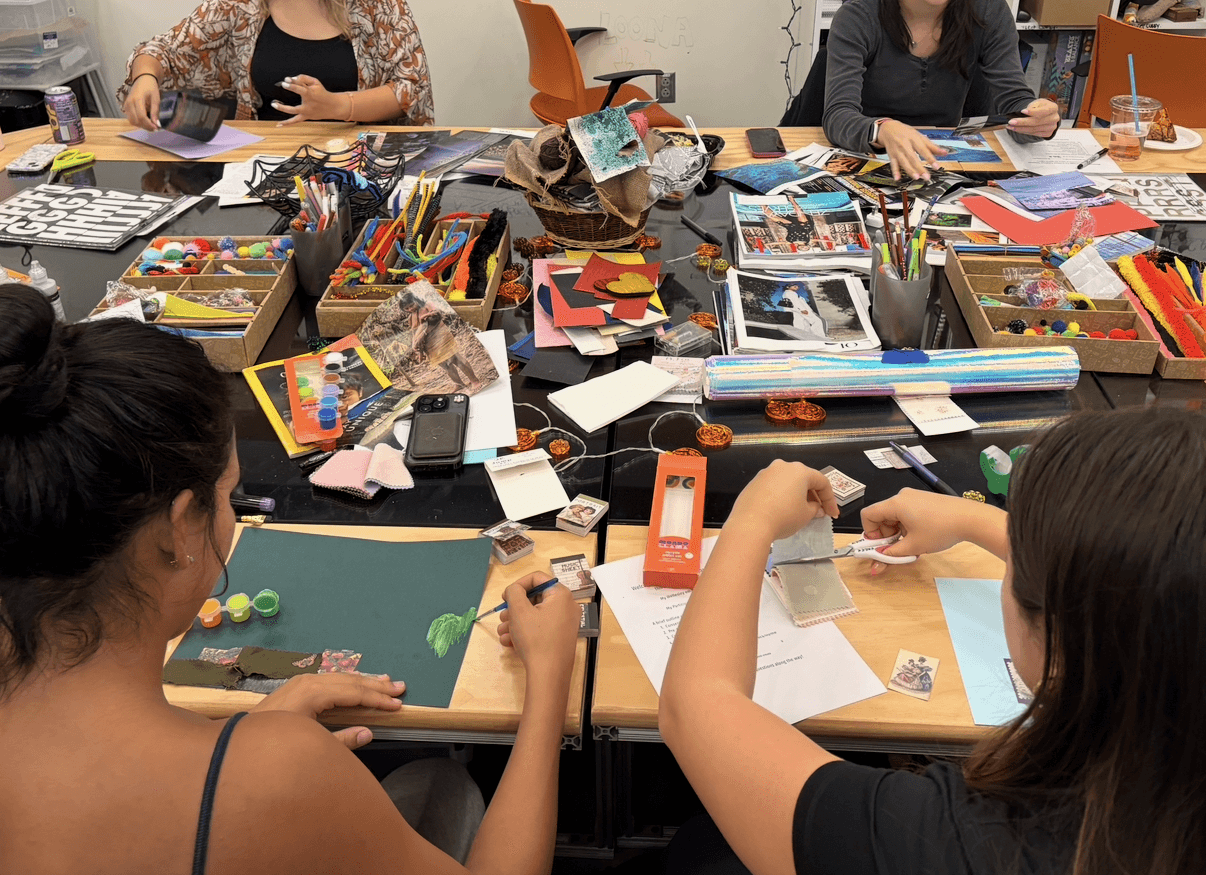
The study examined how AI interaction shaped creative exploration, including divergence from initial ideas, engagement with suggestions, and how creators attributed decisions to themselves or the system.
Material expansion
Counted additions, new material types, and semantic distance from existing collage elements.
Visual analysis
Tracked color diversity and compositional space usage to understand shifts in visual exploration.
Reflection analysis
Analyzed written check-ins for descriptive engagement, conceptual range, adoption, inspiration, and rejection.
Creative orientation
Connected creative self-efficacy and AI attitudes to different engagement patterns.
The System
The Collage Collaborator generated visual suggestions layered over a participant’s in-progress collage. It never edited or finalized physical work; it proposed, and the creator decided what to do with it.
01
Capture
Photograph or upload an in-progress physical collage.

ADD IMAGE
02
Generate
Produce five blurred suggestion cards across distinct dimensions.

03
Explore
Reveal suggestions at a self-directed pace to avoid premature anchoring.

04
Interpret & make
Translate ideas into physical material; the AI cannot implement on the creator’s behalf.

05
Direct
Custom prompting unlocks — user articulates intent and steers the AI toward specific directions.

DESIGNED FOR CREATIVE AGENCY
The system was deliberately designed to suggest without taking control. It could not edit or finish a participant’s collage; every shift required a person to interpret an idea, locate materials, and make a physical decision. That separation turned AI output into a provocation rather than a prescription, protecting authorship while still widening the field of possible next moves.
Designing to branch out
Five cards deliberately spanned different creative dimensions. Presenting them together prevented a single output from becoming the obvious path and invited comparison, combination, and refusal.
Why cards began blurred
Participants revealed cards at their own pace. The initial blur slowed exposure, reduced anchoring on the first visible option, and kept attention on active exploration rather than passive consumption.
What each card type was designed to unlock

Materials
Prompted tactile additions such as foil, yarn, feathers, film, or pompoms to expand material vocabulary.
Form & color
Suggested contrasting colors, geometry, marks, and chromatic emphasis as alternate visual strategies.
Texture
Introduced scraps, torn edges, layering, and surfaces that could shift the collage’s depth and tactility.
Surprise
Used unexpected objects and playful juxtapositions to disrupt a settled composition and provoke new associations.
Theme
Extended the collage’s existing visual narrative with symbols, motifs, or imagery that could be reinterpreted personally.
Direct
Let creators articulate a partial intent—medium, theme, or imagery—and steer the system toward a direction they chose.
What We Found
Across four significant quantitative measures, AI use expanded creative exploration. Crucially, it did so without taking over authorship: the separation between suggestion and physical implementation created space for interpretation, revision, and resistance.
AI expanded materials, not meaning
Material vocabulary broadened, while personal themes, color diversity, and global composition remained creator-led.
Three ways to engage
Participants adopted suggestions directly, used them as partial inspiration, or rejected them deliberately—each an expression of agency.
Resistance was a feature
Refusing or transforming an AI suggestion was not failure; it was evidence that creators were actively negotiating ownership.
Experience shaped the effect
Prior creative orientation changed how participants interpreted suggestions and where the system offered useful support.


01 · Design for interpretation, not automation
Keep implementation in the creator’s hands so each suggestion becomes material for thought, not a finished answer.
02 · Generate diverse alternatives together
Offer simultaneous, varied directions across creative dimensions so no single option becomes the default.
03 · Support breadth and depth modes
Support wide material exploration while leaving room for creators to deepen themes that matter personally.
04 · Validate resistance
Treat refusal, reworking, and contradiction as productive forms of creative engagement—not system failure.
Case Studies

“I used one of the given, automated collages made by the collage co-creator. It inspired me to add items onto my collage that I hadn’t thought of earlier.” -P28

“I wanted to put stuff in the margins but I wasn’t sure how it’d look. It was helpful to see how it would look with the AI and realize I want something similar but a bit different than what it generated.” -P23
CONCLUSIONS & BROADER IMPLICATIONS
The findings suggest a practical direction for creativity tools: design AI as a source of diverse, interpretable prompts rather than an engine for finished output. Future work can build on this through adaptive suggestion systems, more nuanced support for different experience levels, and interfaces that make creators’ evolving intent legible without taking control away.