Urbanity Dance
Introspective Performance. Collaboration with Urbanity Dance.
Year:
2025
Timeframe:
10 Weeks
Tools:
H6M monitors, OSC pipeline, Python
Category:
Creative Technology
Role:
Creative Technologist
Team:
In collaboration with Choreographer Courtney Spero
Overview
An interoceptive performance exploring AI, human connection, and the body as instrument
Challenge
Traditional biofeedback systems reduce physiological data to abstract metrics, limiting emotional resonance and making it difficult to use internal states as a medium for shared, embodied interaction.


URBANITY DANCE · FALL CRAWL
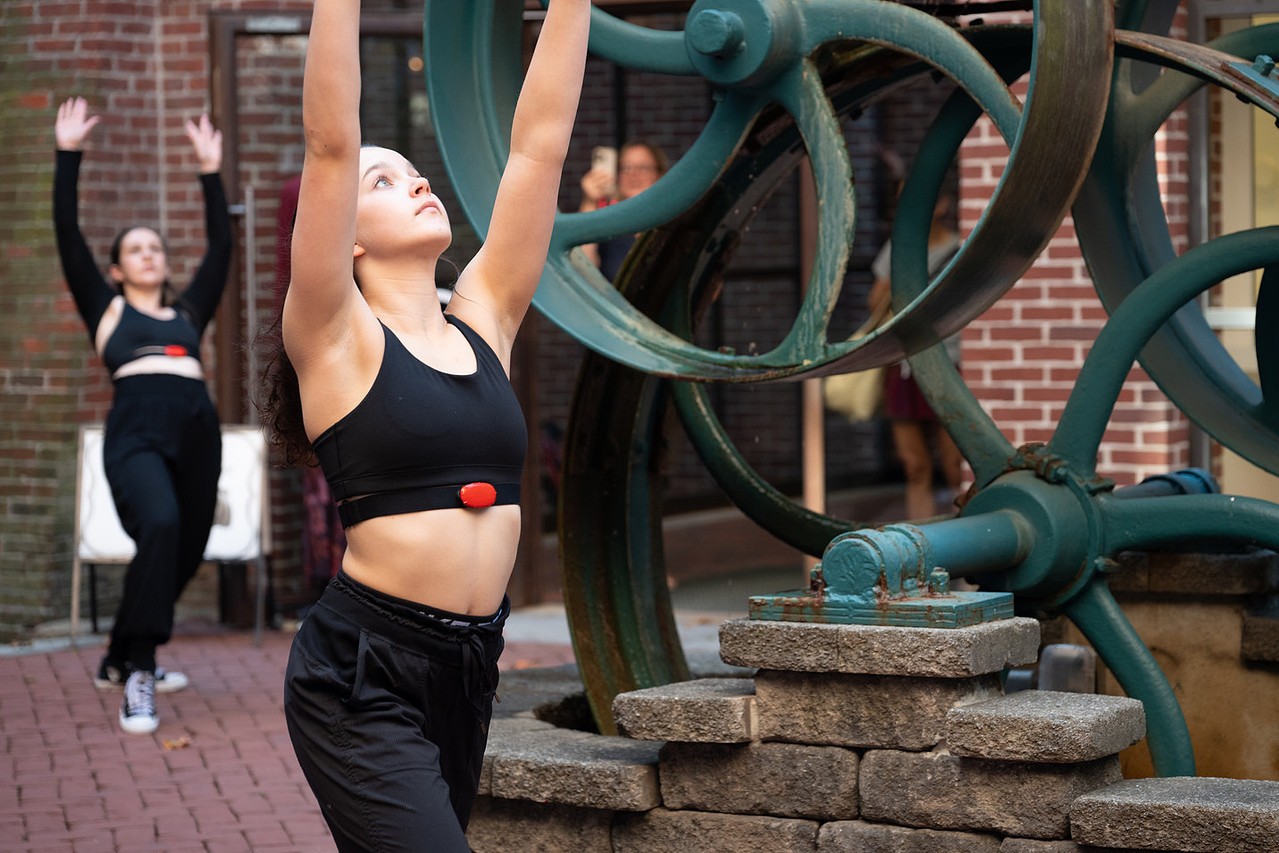
In collaboration with Urbanity Dance, I developed an interactive performance system that translated dancers’ live heart-rate data into sound. The project explored how sensing and AI technologies can shape care, emotion, and collective experience—not by replacing feeling, but by making inner states available for shared attention.
The system treated physiological data as conversation rather than control. Multiple live heart-rate streams remained individually expressive while contributing to one shared, responsive soundscape.
01
Live input
Bluetooth H6M monitors streamed each dancer’s heart rate through OSC.
02
Signal processing
Normalized and smoothed the streams for expressive stability without losing individuality.
03
Expressive mapping
Mapped BPM to tempo, pitch, note decay, and ambient density.
04
Shared output
Layered sonic textures evolved with the group’s rhythm, effort, and connection.

Process & Design
Field research & technical development
I surveyed heart-rate sensors for accuracy, latency, and open-data compatibility, then selected Bluetooth-connected H6M monitors for a reliable, accessible, budget-conscious setup. Iterative calibration preserved the character of each dancer’s signal while enabling a shared audio space.
Calibrating for choreography
Testing focused on the balance between responsiveness and continuity. In sessions with choreographer Courtney Spero, we tuned synchrony, scaling curves, note decay, and how differing heart-rate ranges could shape the conversation between notes and harmonies.

Insight
Real-time synchronization was essential to perceived authenticity. When dancers could hear their individual and collective rhythms respond in the same moment, the data became legible as relational experience.
Iteration
Scaling curves and the emotional pacing of the soundscape were repeatedly tuned to make rapid physiological shifts feel expressive and coherent rather than mechanically reactive.
FUTURE DIRECTIONS
Future versions could use machine learning to interpret emotional synchrony, translate movement into sound, or add visual, light, and haptic feedback. The long-term goal is a set of participatory tools that help people experience embodied data not as a metric, but as a shared language of care and connection.

